7 Proven ABA Therapy Empathy Skills That Truly Transform Social Growth
Teaching Empathy Skills to Children with Autism: How ABA Therapy Empathy Skills Support Social Understanding
Children with autism spectrum disorder (ASD) often experience challenges when navigating social situations. Understanding emotions, interpreting social cues, and responding appropriately can feel overwhelming and confusing. For many families, these challenges lead to frustration, misunderstandings, and emotional stress.
Fortunately, ABA therapy empathy skills provide evidence-based strategies that help children with autism better understand emotions, develop meaningful social connections, and cope with everyday interactions.
Applied Behavior Analysis (ABA) therapy focuses on teaching socially significant behaviors in a structured, measurable, and supportive way. When empathy instruction is integrated into ABA therapy programs, children can learn to recognize emotions, understand perspectives, and respond with appropriate emotional and social behaviors.
This article explores what empathy is, why it can be challenging for children with autism, and how ABA therapy empathy skills can be used to teach empathy effectively. You’ll also find practical strategies, benefits, and tips for parents and caregivers who want to support empathy development at home.
What Is Empathy and Why ABA Therapy Empathy Skills Matter
Empathy is the ability to understand, recognize, and respond to another person’s emotions. It plays a critical role in communication, conflict resolution, friendships, and emotional development. Empathy allows individuals to connect with others, express care, and navigate social expectations.
For children with autism, empathy may not develop naturally or intuitively. This does not mean they do not care. Instead, differences in communication, emotional processing, and social learning can make empathy harder to recognize and express.
ABA therapy empathy skills break empathy into teachable components. Rather than assuming a child will “pick up” social understanding, ABA therapy teaches empathy through direct instruction, modeling, practice, and reinforcement.
Empathy consists of several key components:
Recognizing emotions in others
Understanding why someone feels a certain way
Regulating one’s own emotional response
Responding appropriately through words or actions
ABA therapy helps children learn each of these steps in a clear and structured way.
Why Children With Autism Struggle With Empathy
Children with autism may experience difficulties with empathy for a variety of reasons, including:
Difficulty interpreting facial expressions and body language
Challenges understanding tone of voice or implied meaning
Differences in emotional regulation
Limited social experiences or opportunities to practice
Research suggests that autism does not equal a lack of empathy. Instead, many children experience differences between cognitive empathy (understanding another’s perspective) and affective empathy (emotionally responding to others’ feelings) (Rogers et al., 2007).
ABA therapy empathy skills help bridge this gap by teaching children how to recognize emotions, understand social expectations, and practice appropriate responses in a safe and supportive environment.
Understanding Cognitive and Affective Empathy Through ABA Therapy Empathy Skills
Empathy is often divided into two categories:
Cognitive Empathy
Cognitive empathy involves understanding what another person is feeling and why. This includes perspective-taking, predicting emotional responses, and recognizing social expectations.
Children with autism may struggle with cognitive empathy because it requires abstract thinking and interpretation of social cues. ABA therapy empathy skills address this by teaching emotional recognition and perspective-taking explicitly.
Affective Empathy
Affective empathy refers to feeling concern, compassion, or emotional resonance with another person. Some individuals with autism experience strong affective empathy but struggle to express it appropriately.
ABA therapy supports affective empathy by teaching emotional regulation skills and socially appropriate ways to express care and concern.
What Is Empathy Training in ABA Therapy Empathy Skills?
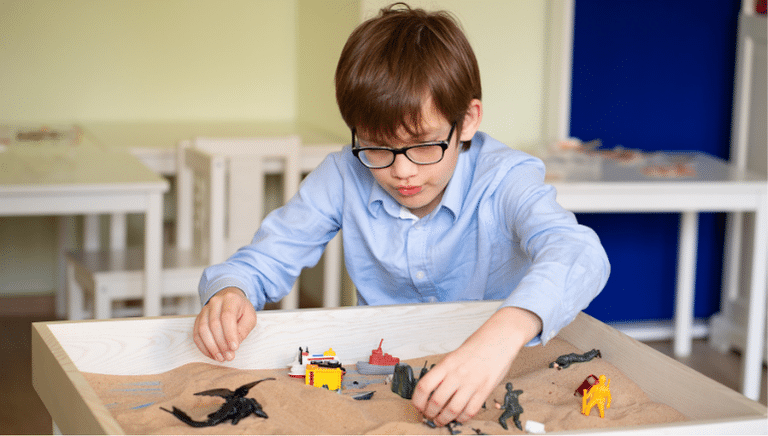
Empathy training is a structured approach used in ABA therapy to teach emotional awareness, understanding, and response behaviors. ABA therapy empathy skills training typically includes:
Emotion identification using visuals and real-life examples
Perspective-taking exercises
Role-playing social scenarios
Reinforcement of empathetic behaviors
ABA therapy focuses on observable behaviors, meaning empathy is taught through actions and communication rather than assumptions about internal feelings.
How ABA Therapy Empathy Skills Teach Emotion Recognition
Emotion recognition is the foundation of empathy. Children must first learn to identify emotions before they can respond appropriately.
ABA therapists use evidence-based techniques such as:
Emotion cards and picture schedules
Videos and social stories
Real-life observation and labeling
Facial expression matching activities
Through repetition and reinforcement, ABA therapy empathy skills help children recognize emotions in themselves and others across different settings.
Teaching Perspective-Taking With ABA Therapy Empathy Skills
Perspective-taking is a core component of empathy. Children with autism may struggle to understand that others have different thoughts, feelings, and experiences.
ABA therapy addresses this by:
Breaking down social scenarios step by step
Asking guided questions (“How do you think they feel?”)
Practicing alternative responses
Reinforcing accurate perspective-taking
With consistent practice, ABA therapy empathy skills help children better understand how their actions affect others.
Using Role-Play to Strengthen ABA Therapy Empathy Skills
Role-playing is one of the most effective tools for teaching empathy. It allows children to practice social situations in a safe, predictable environment.
Common role-play scenarios include:
Comforting a sad friend
Sharing toys
Responding to frustration or anger
Offering help
ABA therapists provide immediate feedback and reinforcement, helping children generalize empathy skills to real-life situations.
Emotional Regulation and ABA Therapy Empathy Skills
Empathy requires emotional regulation. If a child is overwhelmed by their own emotions, it becomes difficult to respond to others.
ABA therapy empathy skills often include:
Identifying personal emotions
Learning calming strategies
Practicing coping techniques
Recognizing emotional triggers
By improving emotional regulation, children become more capable of responding empathetically instead of reacting impulsively.
Benefits of ABA Therapy Empathy Skills for Children With Autism
Teaching empathy through ABA therapy offers long-term benefits, including:
Improved social communication
Stronger peer relationships
Reduced anxiety in social settings
Better emotional awareness
Increased independence
Studies show that social skills training, including empathy development, improves overall quality of life for children with autism (Relias, 2023).How Parents Can Support ABA Therapy Empathy Skills at Home
Parents and caregivers play a crucial role in reinforcing empathy skills outside of therapy sessions.
Model Empathy Daily
Children learn by observing. Demonstrating empathy in everyday situations reinforces lessons learned in therapy.
Talk About Emotions
Label emotions during daily interactions. For example, “You look frustrated” or “She’s happy because you helped her.”
Praise Empathetic Behavior
Positive reinforcement helps children understand which behaviors are socially meaningful.
Create Practice Opportunities
Use books, movies, and daily routines to discuss emotions and social responses.
When combined with professional intervention, home practice strengthens ABA therapy empathy skills significantly.
Common Challenges When Teaching ABA Therapy Empathy Skills
While empathy is teachable, progress may be gradual. Common challenges include:
Difficulty generalizing skills across settings
Sensory overload affecting emotional processing
Inconsistent practice
Consistency, patience, and collaboration with ABA therapists are key to overcoming these challenges.
When to Seek Professional ABA Therapy Empathy Skills Support
If your child struggles with social interactions, emotional understanding, or peer relationships, professional ABA therapy may be beneficial.
ABA therapists design individualized programs that:
Match your child’s developmental level
Address specific empathy challenges
Track progress through measurable goals
Early intervention with ABA therapy empathy skills often leads to better long-term outcomes.
Key Takeaways About ABA Therapy Empathy Skills
Empathy is a teachable skill, not an innate trait
Children with autism can learn empathy with structured support
ABA therapy empathy skills provide evidence-based strategies
Parent involvement strengthens therapy outcomes
Empathy improves social connection and emotional wellbeing
By teaching empathy intentionally, we help children with autism feel more connected, confident, and understood.
Contact us if you have questions and interested with our ABA therapy program.
References
- Relias. (2023). Autism social skills training: Strategies for developing empathy. https://www.relias.com/blog/autism-social-skills-training-strategies-for-developing-empathy
- Rogers, S. J., Dziobek, I., Hassenstab, J., Wolf, O. T., & Convit, A. (2007). Who cares? Revisiting empathy in autism spectrum disorders. Journal of Autism and Developmental Disorders, 37(4), 709–715. https://www.ncbi.nlm.nih.gov/pmc/articles/PMC2649842/
- Verywell Health. (2022). Do people with autism lack empathy? https://www.verywellhealth.com/do-people-with-autism-lack-empathy-259887
- Simmons University. (2021). How to teach apologies to children on the autism spectrum. https://online.simmons.edu/blog/how-to-apologize-children-on-autism-spectrum/
- WikiHow Life. (2023). Teach empathy to an autistic child. https://www.wikihow.life/Teach-Empathy-to-an-Autistic-ChildQ