5 Proven Ways to Boost Autism and Empathy Skills
Understanding Autism and Empathy: Why This Social Skill Matters
Autism and empathy are often discussed together because empathy is a complex social-emotional skill that can be challenging for many children on the autism spectrum. Empathy involves recognizing another person’s emotions, understanding those emotions, and responding appropriately. For typically developing children, empathy begins emerging in toddlerhood. However, for children with autism, empathy may not develop naturally and often requires structured teaching and reinforcement.
Wondra and Ellsworth (2015) define empathy as “vicariously feeling what another person feels as a result of an event they have experienced.” This definition highlights two essential components: understanding another person’s emotional state and sharing or responding to it in a meaningful way. When discussing autism and empathy, it is important to clarify that many children with autism do experience emotions deeply. The difficulty often lies in identifying emotional cues, interpreting social contexts, and demonstrating socially expected responses.
Autism and empathy development plays a critical role in forming friendships, maintaining relationships, and participating successfully in school and community settings. Imagine a child who never responds when a friend is upset or fails to acknowledge when someone is hurt. Over time, peers may withdraw, not because the child lacks care, but because they do not perceive empathetic responses.
The good news is that autism and empathy skills can be taught. Through evidence-based strategies grounded in Applied Behavior Analysis (ABA), children can learn to recognize emotions, express concern, and engage in socially meaningful behaviors. At Thrive Behavior Centers, we believe that supporting autism and empathy growth empowers children to build stronger, healthier relationships that last a lifetime.
What Is Autism and Empathy in Everyday Life?
When exploring autism and empathy, it helps to break empathy into observable and teachable components. Empathy is not just “feeling bad” when someone is sad. It includes:
-
Verbal responses (e.g., “Are you okay?”)
-
Appropriate tone of voice
-
Facial expressions that match the situation
-
Supportive gestures (e.g., patting someone’s back)
-
Contextually appropriate problem-solving
Children with autism may struggle with reading non-verbal cues such as facial expressions, body language, or tone of voice. They may also have difficulty connecting past experiences to present emotional situations. For example, if a peer drops and breaks a favorite toy, a child with autism may not automatically connect that situation to a time they felt disappointed.
Research indicates that empathy can be explicitly taught using structured behavioral interventions (Schrandt et al., 2009). When autism and empathy instruction includes modeling, reinforcement, and repeated practice, children can acquire and generalize empathetic responses across settings.
Importantly, autism and empathy challenges do not mean a child is uncaring. Rather, they may need clear expectations, visual supports, direct instruction, and consistent reinforcement. Understanding this distinction shifts the focus from assumption to empowerment.
1. Attach Autism and Empathy to Observable Behaviors
One of the most effective strategies for strengthening autism and empathy skills is attaching empathy to observable, measurable behaviors. Empathy itself is internal and abstract. However, behavior analysts focus on what can be seen and reinforced.
Ask yourself:
-
What does empathy look like in our family?
-
How do we show empathy toward one another?
-
What specific behaviors reflect empathy?
When teaching autism and empathy, define concrete behaviors such as:
-
Saying, “I’m sorry that happened.”
-
Asking, “How can I help?”
-
Using a concerned facial expression
-
Avoiding smiling when someone is hurt
-
Offering a hug or supportive gesture
By defining these behaviors clearly, parents and therapists can track progress and provide feedback. For example, if a sibling falls and your child says, “Are you okay?” that is a measurable empathetic behavior.
Research supports the idea that structured teaching improves autism and empathy outcomes. Schrandt et al. (2009) demonstrated that children with autism can learn empathetic responding through systematic prompting and reinforcement.
At Thrive Behavior Centers, clinicians often break down empathy into teachable steps, ensuring children understand not only what to say but when and why to say it.
2. Use Positive Reinforcement to Strengthen Autism and Empathy
Positive reinforcement is a foundational principle in ABA. Cooper, Heron, and Heward (2007) define positive reinforcement as presenting a stimulus following a behavior that increases the likelihood of that behavior occurring again.
When teaching autism and empathy, reinforcement is crucial.
If your child demonstrates an empathetic response:
-
Offer specific verbal praise (“I love how you asked your friend if he was okay. That was very kind.”)
-
Provide a preferred activity
-
Give small rewards when appropriate
-
Offer extra playtime or screen time
Specific praise is particularly powerful because it identifies exactly which behavior is being reinforced. Instead of saying “Good job,” say, “That was very thoughtful when you helped your sister.”
Studies on autism and empathy interventions show that reinforcement significantly increases the frequency of appropriate empathetic responses (Argott et al., 2017). Over time, as behaviors become more natural, tangible rewards can fade while social reinforcement continues.
Consistency is key. Reinforcing autism and empathy skills in everyday moments ensures that learning generalizes beyond therapy sessions.
3. Role-Play to Build Autism and Empathy Skills
Role-playing is a powerful and engaging method for teaching autism and empathy. Using dolls, stuffed animals, or action figures, parents can create scenarios that require empathetic responses.
For example:
-
One doll falls and “hurts” its arm.
-
One toy loses a favorite object.
-
One character feels left out.
During role-play, narrate the situation: “This teddy bear fell down. He looks sad. What can we say to him?”
Encourage your child to practice:
-
Identifying emotions
-
Choosing appropriate words
-
Using matching facial expressions
Role-play allows children to practice autism and empathy skills in a low-pressure setting. They can rehearse responses before encountering real-life situations.
Research indicates that structured teaching methods, including modeling and rehearsal, improve acquisition and generalization of empathetic behaviors in children with autism (Argott et al., 2017). The more opportunities children have to practice autism and empathy responses, the more confident and automatic those responses become.
4. Modeling and Prompting Autism and Empathy Daily
Modeling is one of the most natural and effective ways to teach autism and empathy. Children learn by observing how adults respond to emotional situations.
If your child falls:
-
Say, “Are you okay? That must have hurt.”
-
Offer comfort and explain what you are doing.
If something happens to you:
-
Share your feelings clearly: “I feel frustrated because I lost my keys.”
-
Connect it to their experience: “Remember when you couldn’t find your toy? That felt frustrating too.”
Prompting can also be used during peer interactions:
-
Whisper a reminder: “What can you say to your friend?”
-
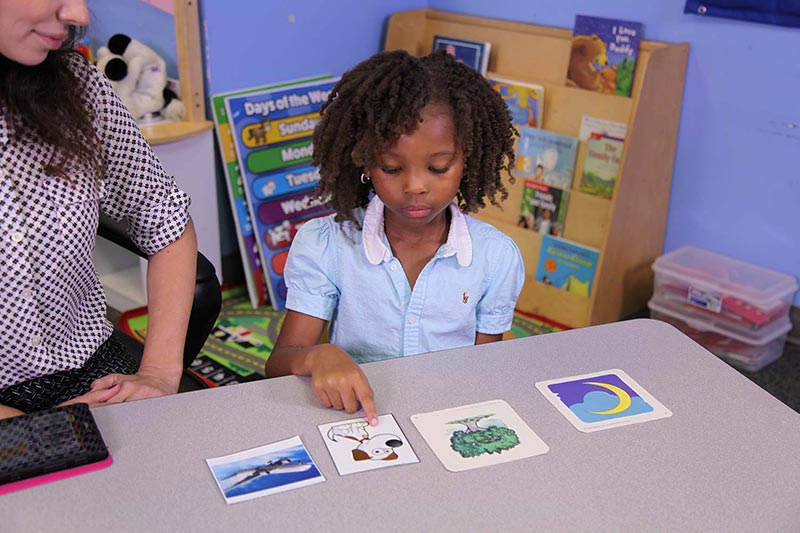
Use visual cue cards showing emotion words.
Research supports modeling and prompting as highly effective in teaching autism and empathy behaviors (Schrandt et al., 2009). Over time, prompts should be faded to encourage independence.
At Thrive Behavior Centers, BCBAs often coach parents to identify natural opportunities throughout the day to reinforce autism and empathy learning. Social skills are not limited to therapy sessions—they occur 24/7.
5. Practice Autism and Empathy Through Structured Situations and I-Messages
Practice strengthens autism and empathy development. Creating structured situations at home can provide safe learning opportunities.
You might:
-
Pretend to feel sad and encourage a response.
-
Have siblings role-play minor conflicts.
-
Practice after reading a story: “How do you think the character feels?”
I-messages are particularly effective. They clearly state emotions and reduce guesswork.
Examples:
-
“I feel sad when you laugh at me.”
-
“I’m upset because my toy broke.”
When emotions are explicitly stated, children with autism can focus on selecting the appropriate response rather than decoding subtle cues.
Teaching children to observe others’ behaviors also supports autism and empathy growth:
-
“The boy is crying. What might he be feeling?”
-
“She is smiling and jumping. How does she feel?”
Repeated, structured practice increases generalization across environments (Argott et al., 2017). The more varied the practice settings, the stronger the autism and empathy skill development.
How Thrive Behavior Centers Supports Autism and Empathy Growth
At Thrive Behavior Centers, our ABA programs focus on individualized treatment plans that target social-emotional development, including autism and empathy skills. We collaborate closely with families to ensure consistency between therapy and home environments.
Our approach includes:
-
Functional behavior assessments
-
Data-driven goal setting
-
Parent training and coaching
-
Natural environment teaching
-
Generalization across settings
Empathy may not always come naturally for children with autism, but with structured support, modeling, and reinforcement, meaningful growth is possible. When autism and empathy instruction is intentional and consistent, children gain tools that help them navigate friendships, school, and community life.
You are not alone in this journey. With professional guidance and evidence-based strategies, autism and empathy skills can flourish, empowering your child to build lasting, meaningful relationships. If you need professional help, contact us here or visit our main website.
References
- Argott, P. J., Townsend, D. B., & Poulson, C. L. (2017). Acquisition and generalization of complex empathetic responses among children with autism. Behavior Analysis in Practice, 10(2), 107–117. https://doi.org/10.1007/s40617-016-0171-7
- Cooper, J. O., Heron, T. E., & Heward, W. L. (2007). Applied behavior analysis (2nd ed.). Pearson Education.
- Schrandt, J. A., Townsend, D. B., & Poulson, C. L. (2009). Teaching empathy skills to children with autism. Journal of Applied Behavior Analysis, 42(1), 17–32. https://doi.org/10.1901/jaba.2009.42-17
- Wondra, J. D., & Ellsworth, P. C. (2015). An appraisal theory of empathy and other vicarious emotional experiences. Psychological Review, 122(3), 411–428. https://doi.org/10.1037/a0039252